What if I told you there's a temple hidden in the Himalayas where no one dares stay during winter, yet the place is said to be protected by an invisible force? A temple so powerful that it stands untouched by avalanches, watched over by a ferocious deity born to slay demons. This isn’t a myth from some fantasy book—it’s the living legend of the Bhairavnath Temple in Kedarnath.
While millions visit the Kedarnath Temple each year, very few know about the mysterious Bhairavnath shrine that silently watches from above. Locals believe it is Lord Bhairav, a terrifying form of Shiva, who becomes the guardian of Kedarnath when humans leave. He is said to have defeated Bhasmasur, protects the temple during six months of deadly snowfall, and is deeply tied to the Pandavas and the very design of the Kedarnath Temple itself, which eerily faces south—toward death.
But what truths lie behind these stories? Legends? Coincidence? Or divine design?
Let’s unravel the 5 greatest mysteries of Bhairavnath Temple that continue to baffle scientists, historians, and spiritual seekers alike.
1. The Guardian of Kedarnath – Lord Bhairav’s Invisible Watch.

When the Kedarnath Temple shuts its doors every winter and the entire valley disappears beneath a thick blanket of snow, something strange happens—something unexplainable yet deeply believed by locals and sages alike. The town is abandoned, no humans remain… but it is said Kedarnath is never truly empty.
Why?
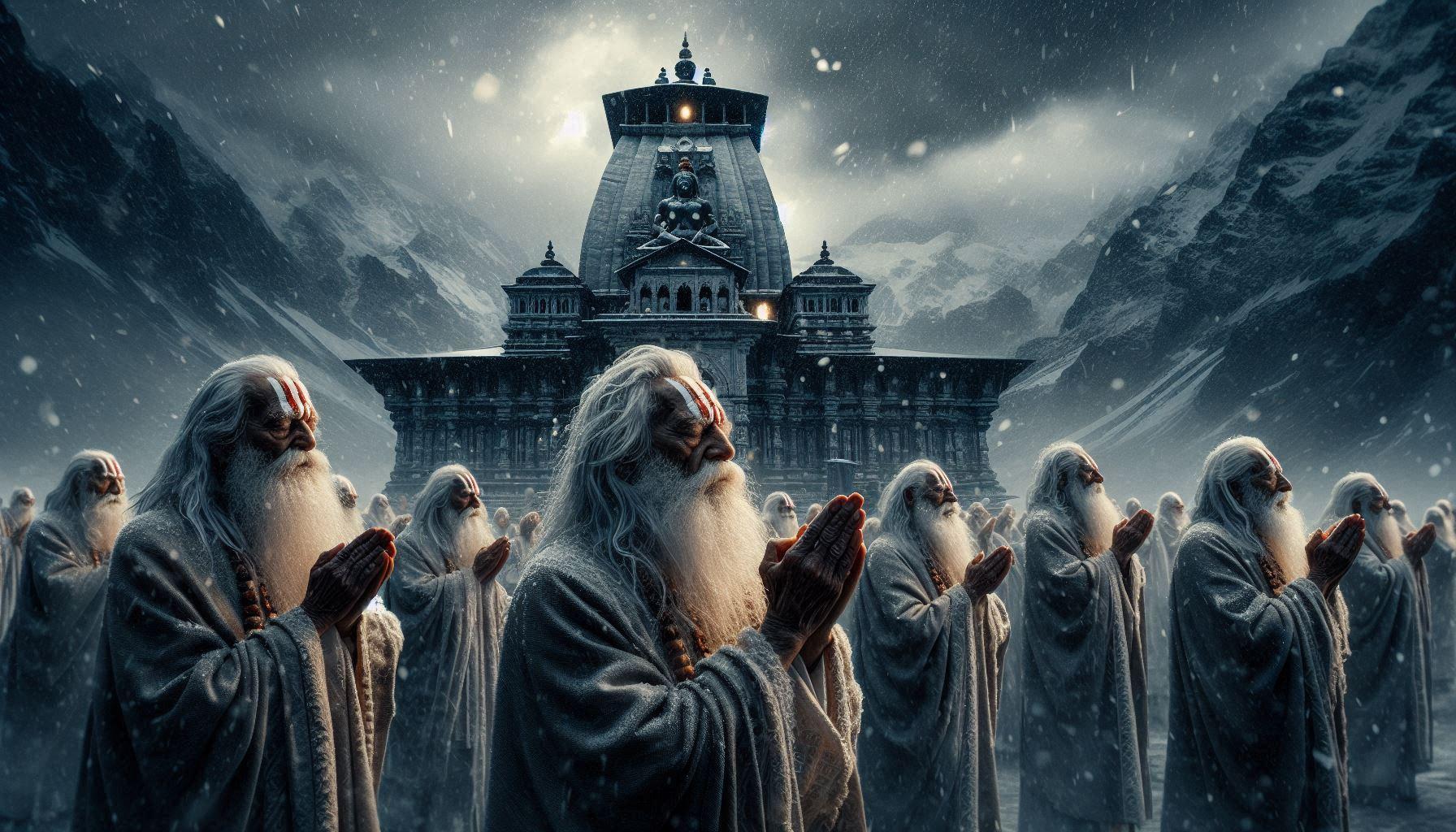
Because Lord Bhairav, the fierce and untamed form of Shiva, remains behind as the sole guardian, watching over the shrine and the sacred valley. Locals call him the Kshetrapal—the protector of the land. Even in sub-zero temperatures, howling winds, and avalanches, no harm ever befalls the Kedarnath Temple. No wild animal dares disturb it. No structure around it collapses while the temple stands strong.
It’s as if a divine force is actively protecting the shrine. Priests even perform a symbolic ritual before closing Kedarnath’s gates each year, requesting Lord Bhairav to take charge until the temple reopens in summer. And the result? For centuries, this mysterious tradition has held true.
How can a temple survive without protection in such harsh weather year after year?
Is it just a legend—or does Lord Bhairav really walk the icy lands, protecting the home of Shiva in absolute silence?
This mystery haunts every pilgrim’s heart.
2. The Winter Vigil, When Only Bhairav Remains.

Every year, as winter storms close in and snow starts to swallow the trails, Kedarnath Temple is sealed shut. The main deity is ritually moved to Ukhimath for worship. But one deity remains behind—Lord Bhairav at Bhairavnath Temple.
What follows is a six-month silence in one of the world’s most remote and dangerous terrains. No humans. No light. No heat. Just snow, ice, and bitter winds. Yet the belief is clear: Kedarnath is never left alone.
Even scientists are baffled by how the temple remains untouched by avalanches that crush everything else around it. Villages nearby vanish under the weight of snow, yet Kedarnath stands like a lone sentinel, year after year. Is this mere engineering? Or is it the protective presence of Lord Bhairav, keeping nature’s fury at bay?
Local legends say Lord Shiva instructed Bhairav to remain as the eternal protector of the temple when Kedarnath is closed. And every priest, without fail, performs a special puja to invoke Bhairav’s guardianship before leaving the site.
What’s even more chilling is this—those who tried to stay back in Kedarnath during winter in the past… never returned.
What happens in those frozen months, deep in the Himalayas, with only Lord Bhairav as witness?
3. The Summoning, Lord Bhairav vs. Bhasmasur.

Hidden within the folds of Himalayan legends is a terrifying tale—the rise of the demon Bhasmasur, who received a boon from Lord Shiva himself. The power? To turn anyone into ashes by merely placing his hand on their head.
Drunk with arrogance, Bhasmasur decided to test this power on none other than Shiva—the very god who granted it! Shiva, realizing the threat, fled through the Himalayas, leaping from peak to peak, seeking refuge. It was during this chaos that Lord Bhairav was born—not as a gentle protector, but as a fierce destroyer.
Summoned by Shiva himself, Bhairav was tasked with saving creation from the demon’s madness. With eyes blazing like fire and a roar that split the mountains, Bhairav slayed Bhasmasur, restoring cosmic balance. This epic battle, believed to have taken place in the region of Kedarnath, established Bhairav as the ultimate guardian, one who answers not with prayers—but with thunder.
Even today, the very land around Bhairavnath Temple feels charged, as if echoes of that ancient clash still ripple through the rocks.
Was Bhairav just a mythological weapon—or a real force that once saved the world?
In the silence of Kedarnath, his legend still breathes.
4. The Pandava Connection, A Temple Forged in Guilt.

Long before modern pilgrims set foot on the Kedarnath trail, five weary warriors walked these same paths—the Pandavas, burdened not by backpacks, but by the weight of their sins.
According to ancient lore, after the bloody war of Mahabharata, the Pandavas were consumed with guilt for the destruction they caused, even though it was fought for dharma. Seeking forgiveness, they set out to find Lord Shiva. But Shiva, displeased and elusive, kept hiding from them—eventually disappearing into the Himalayas.
When they finally found him at Kedarnath, Shiva refused to give them darshan in his original form. Instead, he manifested as a bull and dived into the ground, leaving his hump exposed at Kedarnath. It was here that the first temple structure was believed to be built—by the Pandavas themselves, as an act of repentance.
But here’s where the mystery deepens.
Legends suggest that the Bhairavnath Temple was built nearby to guard this sacred site, not by coincidence, but by divine instruction—because only a fierce protector like Bhairav could guard a place forged from the sins of war.
Are the foundations of Kedarnath soaked in myth, or in the blood-soaked regrets of ancient kings?
Either way, Bhairav watches. Always.
5. The South-Facing Temple and Cosmic Alignment.

Here’s something most devotees never notice—Kedarnath Temple faces south. This may sound trivial, but in Hindu temple architecture, it’s a major anomaly.
Why?
Because south is traditionally the direction of Yama, the god of death. Most temples face east, welcoming the rising sun, symbolizing life, hope, and beginnings. So why does Kedarnath—one of the holiest shrines in India—defy this sacred tradition?
According to spiritual scholars, this is no accident. Kedarnath is the domain of Lord Shiva, the destroyer of ego, illusion, and even death itself. By facing south, the temple symbolically stares death in the eye, declaring that Shiva transcends even the end.
But there’s more.
Researchers and devotees have pointed out a mysterious alignment between the Kedarnath Temple and nearby Himalayan peaks like Kedar Dome and Meru-Sumeru. It's believed that the temple is positioned to channel cosmic energy directly into its sanctum, enhancing its spiritual vibration. Bhairavnath Temple, placed at a strategic distance and elevation, is said to be a part of this geometric energy circuit, serving as both a spiritual battery and protective barrier.
Was this alignment a cosmic coincidence—or did ancient builders understand forces modern science still grapples with?
The south-facing Shiva doesn’t answer. But he watches. And so does Bhairav.
Conclusion, The Silent Guardian of the Himalayas.

As the winds howl through the frozen valleys of Kedarnath, and snow buries every sign of life, one presence remains unshaken—Lord Bhairav, the silent guardian who needs no temple doors, no offerings, no rituals… only unwavering faith.
What makes Bhairavnath Temple so mysterious isn’t just its ancient architecture or terrifying legends—it’s the unseen force that countless devotees, locals, and priests claim to have felt. Whether it’s the temple’s survival through avalanches, the sacred geometry aligning with Himalayan peaks, or the myth of Bhairav defeating Bhasmasur, the energies surrounding Kedarnath are unlike any other place on Earth.
And perhaps, that’s why the temple faces south, staring death in the eye—because here, death is not feared, it’s embraced and transcended. Because this is Shiva’s domain, and Bhairav is his fiercest gatekeeper.
The next time you trek the sacred path to Kedarnath, pause for a moment. Look toward the hilltop where Bhairavnath Temple stands in stoic silence. Ask yourself:
How has this land remained sacred for thousands of years? Who really watches over it when the world turns its back in winter?
Maybe… the answers are not written in books—but whispered in the Himalayan winds, where Bhairav still walks alone.
Bhairavnath Temple FAQs
Who is worshipped at Bhairavnath Temple?
Who is worshipped at Bhairavnath Temple?
Bhairavnath Temple is dedicated to Lord Bhairava, a fierce manifestation of Lord Shiva, who is revered as the guardian deity and protector of the temple.
Where is Bhairavnath Temple located?
Where is Bhairavnath Temple located?
Bhairavnath Temples are found in several parts of India, but some of the most famous ones are located in Vaishno Devi (Jammu & Kashmir), Kathmandu (Nepal), and Maharashtra. Each temple has unique legends and traditions.
What is the significance of Bhairavnath Temple?
What is the significance of Bhairavnath Temple?
Bhairavnath Temple is believed to protect devotees from evil forces and grant courage, strength, and prosperity. Many devotees visit after completing darshan at nearby Shakti Peethas or sacred shrines.
What are the rituals performed at Bhairavnath Temple?
What are the rituals performed at Bhairavnath Temple?
Devotees offer coconuts, liquor, flowers, and black sesame to Lord Bhairava. Special prayers are held on Sundays and during festivals like Bhairava Ashtami.
What are the temple timings of Bhairavnath Temple?
What are the temple timings of Bhairavnath Temple?
Most Bhairavnath Temples open early in the morning around 5:00–6:00 AM and close at night around 8:00–9:00 PM. Timings may vary by location and during special occasions.
What is Bhairava Ashtami and how is it celebrated?
What is Bhairava Ashtami and how is it celebrated?
Bhairava Ashtami marks the appearance day of Lord Bhairava. Devotees observe fasting, offer special prayers, and perform night vigils with chants dedicated to Lord Bhairava.
How to reach Bhairavnath Temple?
How to reach Bhairavnath Temple?
Bhairavnath Temples can be reached by road from nearby towns and cities. For example, Bhairavnath Temple near Vaishno Devi is accessible by trekking from Bhawan, while others are connected by local transport and pilgrimage routes.