When you think of India’s richest entities, names like Mukesh Ambani, Gautam Adani, TCS, and Infosys come to mind. But what if I told you there’s a place — not a corporation, not a billionaire’s empire — that outshines them in assets, income, and smart investments? Welcome to the Tirupati Venkateswara Temple, a divine powerhouse that blends faith with financial genius.
Perched on the Tirumala Hills, this temple holds over 11,000 kg of gold, thousands of acres of land, and fixed deposits worth thousands of crores, earning interest that could fund entire cities. Every day, it collects crores in donations, runs one of the world’s largest hair export businesses, and monetizes every resource — all while feeding lakhs of people and funding charities nationwide.
This is not just a place of worship — it’s one of the smartest and richest institutions in India, operating with the precision of a Fortune 500 company.
Gold & Precious Assets.
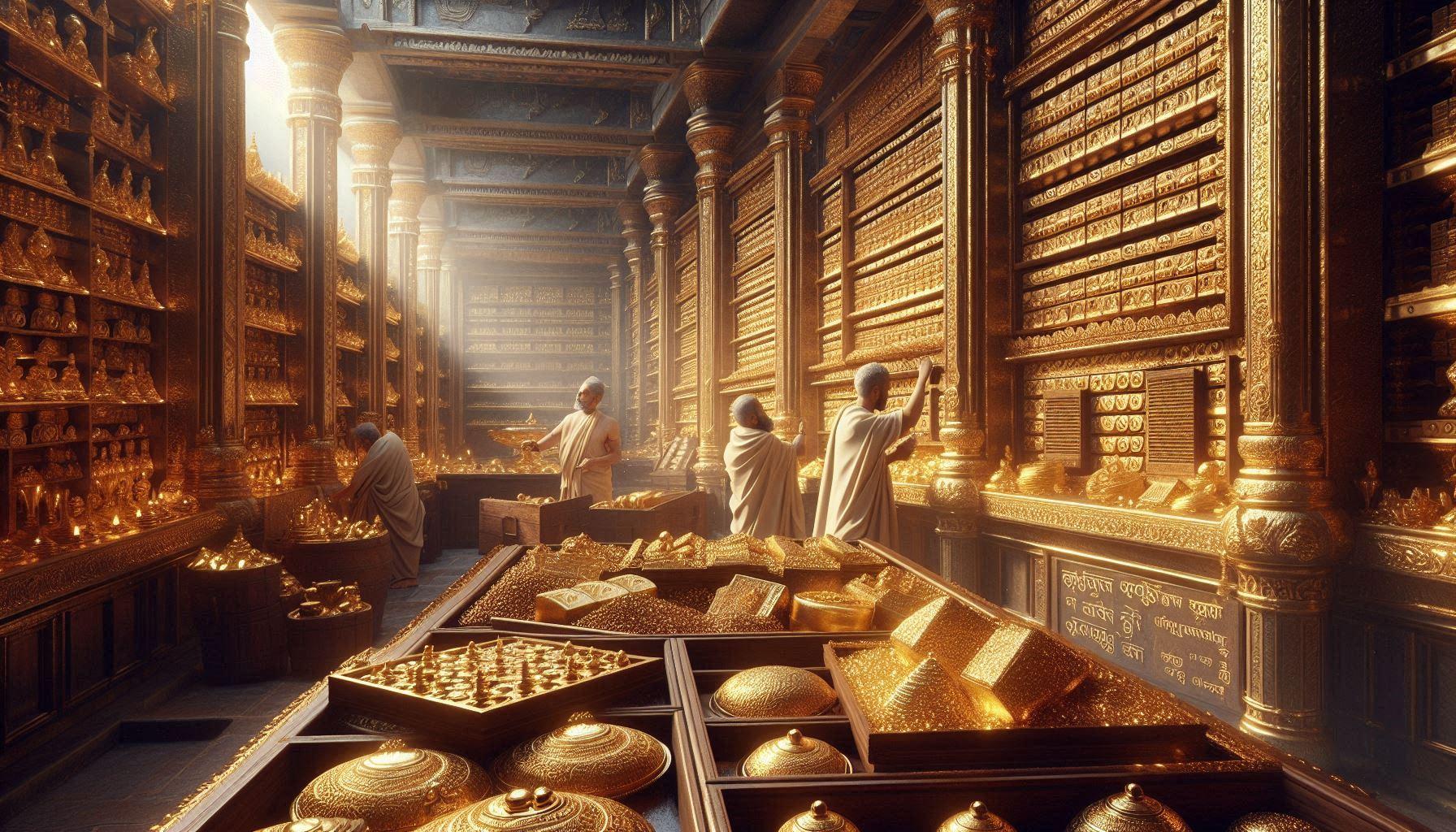
Tirupati Venkateswara Temple is often called a “golden temple” — and for good reason. As of recent estimates, the temple holds over 11,329 kg of pure gold in various forms: bars, coins, and ornaments donated by devotees over centuries. This massive treasure is not locked away idly. Instead, the temple management — Tirumala Tirupati Devasthanams (TTD) — invests a large portion of it through the Gold Monetization Scheme in leading nationalised banks like SBI, Indian Overseas Bank, and Corporation Bank.
Under this scheme, the gold is deposited with the banks, which in turn pay annual interest — sometimes in gold, sometimes in cash — adding crores to the temple’s income without selling a single gram. Some estimates suggest the annual earnings from these deposits cross ₹20–25 crore just from interest.
The remaining gold, including crowns, necklaces, and ornaments, is reserved for daily rituals and grand festivals — each piece priceless, not just in monetary terms, but as a symbol of centuries of faith and devotion.
Land Empire.

Tirumala Tirupati Devasthanams (TTD) oversees one of India’s most formidable real-estate portfolios—spanning about 7,123 acres across the country, encompassing 960 properties in the form of land parcels, buildings, and temple sites. These assets are not just held—they generate tangible income. Market valuations place the total worth of these properties at around ₹85,705 crore, although fair-market estimates suggest it could exceed ₹2 lakh crore. Historically, TTD once owned up to 8,088.89 acres (across 1,128 assets) but divested roughly 335 acres via auctions between 1974 and 2014, now retaining 7,753.68 acres of both agricultural and non-agricultural land. Many of these lands are leased out—farmlands, kalyana mandapams (wedding halls), guest cottages, and commercial spaces—bringing in consistent rental and lease income. This strategic leasing transforms TTD’s donations into stable, long-term revenue streams, reinforcing its financial muscle with both scale and smart monetization.
Fixed Deposits & Cash Reserves.

Tirumala Tirupati Devasthanams (TTD) isn’t just a temple—it’s a strategic financial institution. As of April 2024, TTD’s combined fixed deposits across its main body and subsidiary trusts amount to a staggering ₹13,287 crore, and its total cash balances—including in its various trusts—have reached ₹18,817 crore, What makes this monumental? The annual interest earnings on these fixed deposits alone are estimated at approximately ₹1,600 crore—making FD interest TTD’s second-largest revenue source after its hundi (donation chest). Over the past decade, TTD has consistently added to its FD corpus, with deposits growing from ₹4,820 crore in 2012 to the present figure.
To manage liquidity effectively, especially during the COVID-19 pandemic, TTD shifted many deposits to monthly interest payouts and began reinvesting in higher-yielding central and state government securities aimed at stabilizing the temple’s cash flow.
This multi-billion rupee FD strategy ensures that Tirupati’s sacred funds keep growing—earning steady returns while preserving capital.
Hair Donation Industry.

Tirupati runs tonsuring like a factory—free tonsure at multiple Kalyanakatta halls, with antiseptic prep and trained barbers working in shifts. Hair is collected immediately, tagged, and moved to secured stores. It’s then sorted by length/quality (A/B/C grades), cleaned, dried, bundled, and listed for monthly e-auctions—a system TTD adopted to maximise prices and transparency.
Annual revenue from hair fluctuates with global demand but routinely clocks ₹125–200+ crore; for example, TTD has projected ~₹151 crore in recent budgets, while earlier years touched ₹200 crore+. Individual auctions have fetched ₹80+ crore for ~52 tonnes, and cumulative multi-year sales crossed ₹600+ crore when backlog stock was cleared.
After auction, bulk buyers export to Italy and China for wig/extension processing; finished products flow to the US/EU beauty markets. Reports describe Tirumala as a key node in this global supply chain, turning devotional offerings into a multimillion-dollar export business that funds TTD’s charities and operations.
Beyond gold, land, and hair sales, Tirupati’s wealth is fueled by a variety of steady income sources. The famous Tirupati Laddu itself is a revenue powerhouse—TTD makes over 10 lakh laddus daily, selling them at subsidised rates to devotees but still generating hundreds of crores annually due to the sheer volume. Special prasadam like pulihora (tamarind rice) and daddojanam (curd rice) are also sold in large quantities.
Darshan tickets form another major source. While the free Sarva Darshan is open to all, lakhs opt for paid Seva or Special Entry tickets (₹300 or more), which collectively bring in massive sums. Corporate and individual donations—either as one-time offerings or through special schemes—pour in regularly.
TTD also auctions ornaments and jewelry offerings made by devotees, some embedded with diamonds and rare gems. Even the interest from cash offerings in the Hundi becomes a revenue stream when temporarily deposited before use.
From letting out TTD marriage halls and guest houses to leasing commercial spaces, every resource is optimised. Combined, these “other” sources ensure that the temple’s wealth is not dependent on any single stream, but flows from multiple channels—making Tirumala’s economy as divine as its deity.
Billionaire & Company Comparisons.

Tirumala Tirupati Devasthanams (TTD) isn’t just a temple trust—it’s an economic giant. With an annual income exceeding ₹4,000 crore (excluding asset value), Tirupati often outperforms some of India’s biggest corporate names in pure yearly earnings. For perspective, the personal annual income of billionaires like Mukesh Ambani or Gautam Adani—drawn from dividends and salaries—pales in comparison to the temple’s steady, donation-driven flow.
Even when compared to corporate giants, Tirupati’s numbers are staggering. Infosys reported a net profit of around ₹26,000 crore in FY24, while TCS earned over ₹45,000 crore. While these IT titans rely on volatile market conditions, TTD’s income is consistent and recession-proof, driven by faith, tourism, and centuries-old traditions.
In essence, Tirupati operates like a mega-corporation with diversified revenue streams, unrivaled customer loyalty, and an unshakable “brand” that has stood strong for over a thousand years—making it spiritually sacred and financially untouchable.
Conclusion, The Divine Billionaire of India.

Tirupati Balaji Temple is not just a place of worship—it is a financial powerhouse that blends ancient devotion with modern economic genius. From gold reserves rivaling central banks, thousands of acres of prime land, and interest-generating fixed deposits, to its thriving hair export business and laddoo sales, Tirupati has built a diversified portfolio like no other. Its annual income comfortably competes with India’s biggest corporations, yet every rupee is reinvested into serving millions of devotees and funding charitable causes. Here, wealth is not an end goal—it is a means to sustain faith, tradition, and service for generations to come.